Best Practice Mould Remediation in Australian Restoration Industry
Mould remediation has become one of the most discussed subjects in today’s restoration sector—and for good reason. Claims are increasing, building designs are changing, and expectations from insurers, hygienists, and occupants are higher than ever.
Mould isn’t just a stain. It isn’t just an odour. And it certainly isn’t a “simple cleanup task”.
It’s a building science problem.
It’s a contamination control problem.
And it requires a trained mould remediation specialist — not guesswork.
This article outlines the fundamentals: what mould is, why it forms, its impact on health and materials, and what correct remediation looks like. We also break down common myths and highlight where ACRA training can take your team from competent to industry-leading.
Understanding Mould: Conditions and Classifications
Mould contamination can be classified into three key Condition levels. These categories are essential for scoping, containment strategy, WHS requirements and insurance decision-making.
Condition 1 – Normal Fungal Ecology
An indoor environment reflecting what is naturally expected—settled spores, fragments, and microscopic traces at normal background levels.
Condition 2 – Settled Spores
An environment where spores have migrated from a contaminated area. There may be early surface traces or dormant fragments, but no established colony.
Condition 3 – Actual Growth
Active, dormant, visible or hidden fungal growth. This is true contamination requiring structured remediation, containment, and verification.
Why this matters:
Classifying mould correctly informs risk, labour requirements, equipment selection, and documentation standards. It also helps insurers understand scope justification.
What Does Mould Look Like?
Mould is deceptive. It may appear as:
Green, black, white, brown or orange spotting
Circular patches or diffuse “dusty” areas
Staining beneath paint or wallpaper
Soft, fuzzy, feathery or velvety texture
No visible growth at all, yet strong odour or elevated readings
When it comes to mould, it is crucial to understand that what you see is rarely the full extent. Moisture mapping and environmental measurement remain essential.
Health Impacts: Why Correct Remediation Matters
High humidity and mould-contaminated environments can irritate the respiratory system and disrupt occupant wellbeing. Symptoms may include:
Eye, nose and throat irritation
Persistent cough or chest tightness
Hoarseness or breathing difficulty
Recurring sinus infections
Headaches and fatigue
Difficulty concentrating
For insurers and restoration companies, these health impacts underline the need for correct containment, PPE, and verification testing—not just visual cleaning.
Why Does Mould Happen?
Mould develops for only one reason: excess moisture. But the source can vary depending on the history of the building, the age, environment etc.
Older Buildings
Historic water damage
Leaking roof tiles, gutters, pipes
Poor insulation causing cold surfaces
Condensation forming inside wall assemblies
Newer, Airtight Homes
Modern construction traps moisture unless ventilation is managed well.
Steam from cooking, bathing, drying clothes
Insufficient exhaust systems
Poor airflow due to energy-efficient design
Inadequate humidity control
Regardless of building age, mould is the result, not the cause.
Correct Remediation: What Professionals Should Be Doing
Professional mould remediation services is not “wiping down”.
It is a structured process built on assessment, building science and contamination control.
1. Identify the Moisture Source
No remediation stops mould unless the moisture problem is fixed.
2. Determine the Contamination Level (Condition 1, 2, 3)
This defines containment size and WHS risk.
3. Establish Containment
Physical barriers
Decontamination zones
Negative pressure
HEPA-filtered air scrubbing
Containment protects unaffected areas—a critical requirement for commercial and insurance-managed work.
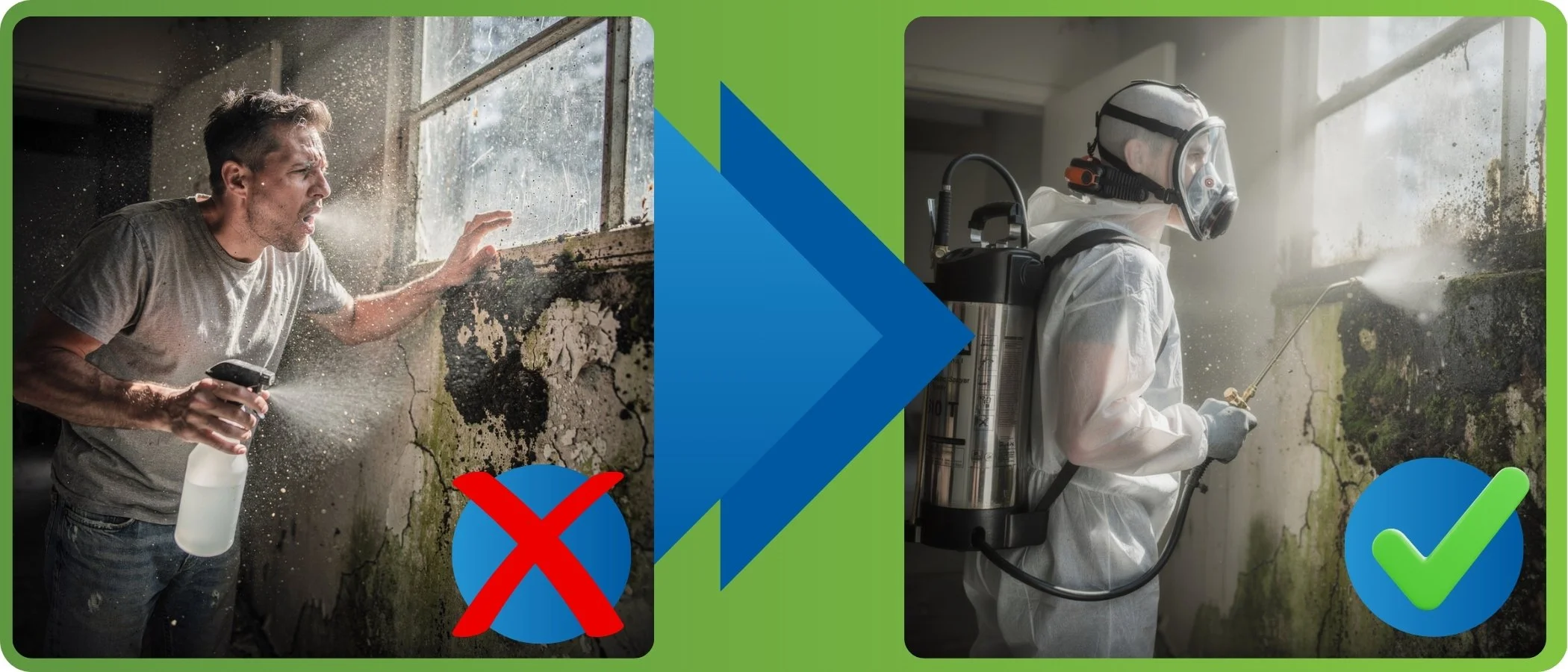
4. Use Correct PPE
Including but not limited to:
Disposable suits
Boot covers
Nitrile or chemical-resistant gloves
P2 or full-face respirators
Eye protection
5. Mechanical Removal & Cleaning
Effective remediation includes:
HEPA vacuuming of surfaces
Removal of unsalvageable porous materials
Mechanical agitation (brushes, pads, scrubbing tools)
Comprehensive surface cleaning
Air cleaning and final wipe-down procedures
6. Appropriate Cleaning Products
Professional-grade solutions used in Australia typically fall into three categories:
Stabilised Chlorine Dioxide (ClO₂) – oxidising, suitable for broad applications
Hydrogen Peroxide Formulations – effective on organic contamination
Quaternary Ammonium Compounds – antimicrobial control for specific applications
What matters is choosing products that don’t leave harmful residues and are fit for purpose based on surface type and WHS requirements.
7. Verification and Clearance
Professionals may use:
Moisture measurements
Particle counting
Surface hygiene verification e.g., A3 testing (ATP/AMP/ADP)
Independent clearance sampling (air or surface testing)
Verification protects the contractor, the insurer, and the occupant.
Breaking the Myths: What We Must Stop Repeating
Myth 1 – “Bleach kills mould.”
Bleach may remove surface staining but does not address hyphae inside porous materials. It also does not stop regrowth.
Myth 2 – “If you can’t see mould, it isn’t there.”
False. Hidden growth is common inside wall cavities, under flooring, behind cabinetry, or within insulation.
Myth 3 – “A chemical spray is enough.”
Professional mould remediation services requires mechanical removal, not just chemical treatment. Spraying alone is not a recognised or defensible method.
Myth 4 – “Mould only happens in old or poorly maintained homes.”
New energy-efficient homes are among the most common sites due to trapped humidity and insufficient ventilation.
Myth 5 – “Air fresheners or odour control solves the problem.”
Odours are caused by microbial volatile organic compounds (mVOCs). Only proper remediation removes the source.
Busting these myths helps professionals communicate clearly, set realistic expectations, and justify correct scope to insurers.
Preventing Mould: Long-Term Control
A mould remediation specialist should guide clients towards long-term prevention:
Maintain indoor relative humidity below 70%
Ensure timber moisture stays below 15%
Improve ventilation in bathrooms, laundries and kitchens
Use mechanical extraction and ensure it vents externally
Consider protective coatings in inaccessible structural areas
Address building defects that trap moisture
Prevention reduces future claims and protects building integrity.
Want to Master Mould Remediation? Train With ACRA
This article provides a broad overview—but the real depth comes from professional training.
ACRA’s mould remediation programs offer:
Hands-on containment setup
Practical HEPA equipment use
Chemical selection and WHS compliance
Moisture detection and building science
Documentation skills for insurers
Real-world case studies and demonstrations
Updates on Australian standards and industry expectations
Whether you’re a technician, supervisor, assessor or insurer, ACRA training ensures you stay aligned with best practice, compliance, and modern building challenges.
Stronger knowledge = safer buildings, better claims outcomes, and a more professional industry.