
Positive vs Negative Pressure Containment in Restoration
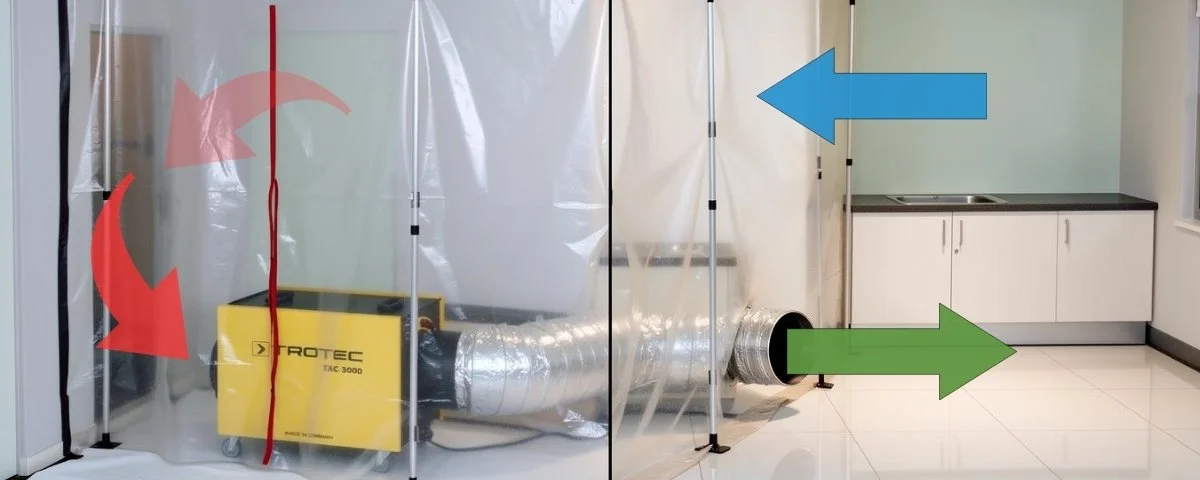
A Practical Guide for Australian Restoration Projects in Peak Summer
Peak Australian summer brings sustained humidity, heavy rainfall, storm events, and ideal conditions for water damage and mould growth. During this time, restoration projects frequently involve active drying, mould remediation, and staged works in occupied buildings.
While containment is often thought of as plastic walls and tape, pressure control is what determines whether containment actually works. Understanding when and how to apply negative pressure, positive pressure, or neutral pressure is critical to preventing cross-contamination, protecting occupants, and achieving effective drying outcomes.
This guide explains how pressure works in containment, how to apply it in real-world Australian scenarios, and what to consider on both short-term and long-duration restoration projects.
Understanding Pressure in Containment
Air always moves from high pressure to low pressure. In containment, this principle is used to deliberately control:
The direction air travels
Whether contaminants are contained or spread
Whether moisture-laden air is allowed into a drying environment
Pressure differentials are created using air cleaner devices or ventilators, combined with correctly installed containment.
A manometer is used to measure and verify that the intended pressure relationship is being maintained throughout the project.
Negative Pressure Containment
Preventing Cross-Contamination
Negative pressure means the air pressure inside the containment is lower than the surrounding environment.
If the containment is breached:
Air flows into the contained area
Contaminants remain trapped
Clean areas are protected
When Negative Pressure Is Required
Negative pressure is the default and preferred method for any work involving contamination.
Common Australian applications include:
Mould remediation
Sewage or Category 3 water losses
Fire and smoke particulate contamination
Removal of contaminated materials
This approach aligns with ANSI/IICRC S520, which requires containment strategies that prevent the spread of mould spores and particulates.
Equipment Configuration
Air cleaner device positioned to draw air from inside containment
Filtered exhaust discharged externally or to a controlled location
Fully sealed containment
Pressure verified using a manometer
Positive Pressure Containment
Controlling External Moisture and Air Ingress
Positive pressure means the air pressure inside the containment is higher than the surrounding environment.
If the containment is breached:
Air flows out of the contained space
External air is prevented from entering
When Positive Pressure Is Appropriate
Positive pressure is used for environmental and moisture control, not contamination control.
A common summer example:
Drying a structure in North Queensland or coastal regions during ongoing rainfall
External air is warm and moisture-laden
Introducing that air would slow or stop drying
The drying zone is placed under positive pressure to prevent wet air entering
Other suitable uses include:
Structural drying during prolonged wet weather
Protecting controlled drying environments from high outdoor humidity
Clean Air Delivery setups where contamination is not present
⚠️ Positive pressure must not be used in contaminated environments, as it can force contaminants into adjacent areas.
Neutral Pressure
Filtration Without Directional Control
Neutral pressure occurs when air is:
Continuously filtered
Recirculated within the same space
Not intentionally exhausted or introduced
Typical uses include:
General air quality improvement
Odour control
Supplementary support during drying
Neutral pressure does not provide containment protection and should not be relied upon where contamination control is required.
Mixed-Condition Buildings
One Contaminated Room in an Otherwise Clean Structure
This is one of the most common residential and commercial scenarios.
Correct approach:
Fully contain the contaminated room
Place the room under negative pressure
Maintain higher pressure in surrounding clean areas
Result:
Air flows from clean areas into the work zone
Contaminants are contained
Occupied or unaffected areas remain safe
Reverse Conditions
One Clean Room in an Otherwise Contaminated Building
In some projects, a single clean or critical room must be protected while surrounding areas are contaminated.
Correct approach:
Fully contain the clean room
Place the room under positive pressure
Ensure air flows outward from the protected zone
This setup is commonly used in:
Commercial facilities
Critical infrastructure environments
Staged remediation projects
Long-Duration Projects: When Plastic Containment Is Not Enough
During peak summer, many restoration projects extend over weeks rather than days. In these situations, temporary plastic containment may no longer be practical or appropriate, particularly where:
Occupants remain in the building
Children or pets are present
Access between zones is frequent
Multiple storeys are involved
A common example is a two-storey home where the ground floor has flooded, requiring extensive drying and restoration while occupants continue to live upstairs.
In these cases, containment must still control airflow and pressure — but the construction method often needs to change.
Temporary Fixed Containment Construction
For long-term or occupied works, it may be necessary to construct temporary fixed containment walls instead of relying solely on plastic.
These structures provide:
Greater durability
Improved safety in occupied homes
Consistent pressure control over time
Reduced risk of accidental failure
Typical Applications
Ground-floor restoration with upper levels occupied
Extended mould remediation projects
Commercial buildings operating in stages
Projects involving demolition and long drying cycles
Suitable Materials for Fixed Temporary Containment
Temporary containment walls should be built using solid, low-permeability materials that can be effectively sealed.
Common materials include:
Timber or lightweight steel framing
Plasterboard
Compressed fibre cement sheeting
Temporary modular wall systems
Plastic sheeting may still be used:
As an internal lining
As an air or vapour barrier
At interfaces with existing structures
Preventing Air Gaps: The Critical Factor
Regardless of the material used, air gaps are the most common cause of containment failure.
Key Areas to Address
Floor-to-wall junctions
Ceiling voids and cornices
Skirting boards
Stairwells and service penetrations
Door frames and access points
Best-Practice Sealing Methods
Seal all perimeter edges using appropriate tapes or sealants
Use expanding foam or backer rod for irregular gaps
Seal penetrations for cables, hoses, and ducting
Do not rely on friction-fit panels or gravity alone
Even small gaps can:
Neutralise pressure differentials
Allow contaminated or humid air to migrate
Undermine the effectiveness of air cleaner devices
Pressure Control in Fixed Containment
Temporary fixed containment must still be actively managed using pressure principles:
Negative pressure for contaminated work zones
Positive pressure for clean or occupied protection zones
Pressure verified and monitored using a manometer
Air cleaner devices must be correctly sized for the enclosed volume and configured to suit the pressure strategy.
Verifying Air Cleaner Performance Within Containment
When air cleaner devices are used within containment, particularly on mould remediation or contaminated water loss projects, it is critical that the equipment is actually removing airborne particles rather than redistributing them.
HEPA Filtration Requirements
Air cleaner devices should be fitted with H13 or H14 HEPA filters:
H13: ≥99.95% efficiency at 0.3 microns
H14: ≥99.995% efficiency at 0.3 microns
Filters must be:
Correctly installed and sealed
Free from damage or bypass
Changed in line with manufacturer guidance and job conditions
A high-grade filter alone does not guarantee performance.
Functional Verification Using Particle Counters
When using air cleaners in containment, functional verification should be undertaken.
A particle counter can be used to measure airborne particles:
At the air intake
At the filtered air discharge
In adjacent clean or occupied areas
A correctly operating air cleaner device should show:
Reduced particle counts at the discharge
No increase in particle levels in surrounding areas
Elevated or increasing counts may indicate:
Filter failure or incorrect installation
Internal leaks
Equipment unsuitable for the application
Containment or pressure issues
Why Verification Matters
Without verification:
Containment performance may be assumed incorrectly
Contaminants may be spread unintentionally
Occupant and technician exposure risk increases
Verification provides:
Confidence the system is working as intended
Objective evidence of due diligence
Early identification of failures or setup issues
Occupant Safety and Practical Considerations
Where occupants remain in the building:
Access points should be limited and clearly defined
Doors into containment should be self-closing where possible
Restricted areas should be clearly signed
Noise, airflow, and odour pathways should be considered
These measures demonstrate:
Risk-based decision making
Compliance with WHS obligations
A higher standard of professional restoration practice
Why Pressure Control Is Critical in Summer
Peak summer conditions increase:
Humidity levels
Speed of mould growth
Frequency of water losses
Risk of secondary damage
Correct pressure management:
Improves drying efficiency
Prevents cross-contamination
Protects occupants and technicians
Aligns work with Australian standards
Key Takeaways
Negative pressure protects clean areas from contamination
Positive pressure protects clean or dry areas from external air and moisture
Neutral pressure provides filtration only
Long-term projects may require temporary fixed containment
Airtight sealing is essential for pressure control
Air cleaner devices should use H13 or H14 HEPA filters
Performance should be verified using particle counting
Always verify pressure using a manometer