Using Swab Testing to Build Better Cleaning Habits
Turning Routine Cleaning Into a Science-Based Training Tool
In the cleaning and restoration industry, consistency is everything. A surface that looks clean isn’t always hygienically clean—and that’s where swab testing comes in.
Beyond being a verification method, a swab test serves as one of the most effective hands-on training tools for cleaning teams. It turns abstract hygiene standards into visible, measurable results—ideal for toolbox talks, refresher training, or onboarding new staff.
What Is Swab Testing and Why It Works
This method measures residual organic material left on a surface after cleaning. By using a specialized swab to collect samples, we can detect Adenosine Triphosphate (ATP) and its degradation products.
Not All Swab Tests Are Equal:
Traditional Swab Testing (ATP Only): Measures only ATP. While useful, ATP can degrade quickly when exposed to heat, chemicals, or time, potentially leading to "false pass" results even if organic residue remains.
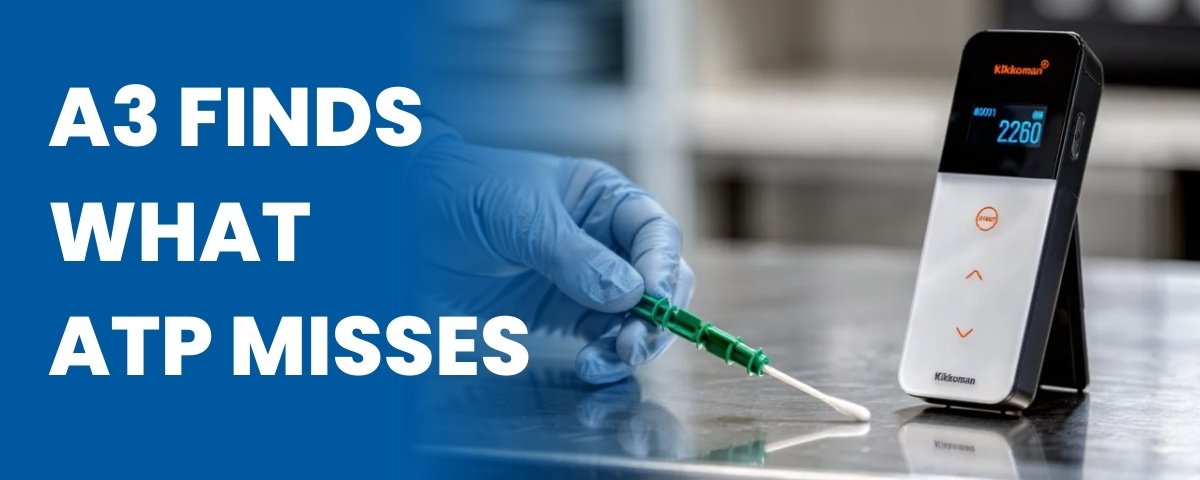
Advanced A3 Testing (ATP+ADP+AMP): This newer standard detects ATP plus its breakdown products: ADP and AMP. Because organic soil (like food residue or skin cells) often contains these stable markers, A3 testing offers up to 20 times the sensitivity of traditional tests, ensuring a "pass" truly means the surface is clean.
A handheld luminometer reads light output from the swabbed surface, displayed as Relative Light Units (RLU). The lower the RLU, the cleaner the surface. It’s fast, objective, and provides immediate feedback—making it a perfect fit for live demonstrations.
Swab Testing as a Training Tool
When used in training, swab testing helps technicians see the science behind cleaning. Instead of relying on visual judgment alone, teams learn how correct methods, dwell times, and product selection translate into measurable hygiene outcomes.
In practice:
A trainer swabs a surface before cleaning and records the RLU.
The surface is cleaned using approved procedures.
A post-clean swab (ideally an A3 swab for maximum accuracy) is tested and compared to the first result.
That instant feedback creates a powerful learning moment. Staff can immediately connect technique with result—reinforcing habits that lead to consistent, high-standard cleaning.
Creating Replicable Training Standards
Businesses can use swab testing to establish repeatable and measurable training protocols across all sites or teams.
Steps to standardize training:
Baseline Testing: Measure RLU readings from common touchpoints to set a reference for what’s considered “clean” within your facility.
Set Pass/Fail Limits:
Pass: Surface is hygienically clean (low RLU).
Re-clean: Moderate RLU; review technique or dwell time.
Fail: High RLU; retrain or review process.
Integrate Into Toolbox Talks: Use swabbing demonstrations in regular meetings to reinforce technique and test random areas.
Record and Compare: Keep a log of swab readings to track trends and identify training needs.
This approach transforms swab testing into a continuous improvement tool, not just a compliance check.
Why Businesses Should Use Swab Tests in Toolbox Talks
Interactive learning: Swab testing turns toolbox talks into live demonstrations where everyone can see measurable outcomes.
Immediate reinforcement: Teams instantly understand the effect of skipping steps or cutting dwell time.
Builds engagement: Friendly competition (e.g., “cleanest site” challenge) helps reinforce learning.
Supports WHS and quality systems: Objective data aligns with internal auditing, client reporting, and hygiene assurance.
Swab testing bridges the gap between training and verification — it’s education and evidence rolled into one.
Building a Culture of Measurable Clean
By incorporating swab testing into toolbox talks and in-house training, businesses can create a culture of measurable clean — where every staff member understands that “clean” isn’t just a visual standard, it’s a performance metric.
Whether used in a commercial cleaning business, aged-care facility, or restoration company, swab testing gives trainers and supervisors the ability to:
Validate technique objectively
Demonstrate continuous improvement
Embed consistent, science-based cleaning habits across all staff
In short, swab testing turns every training session into a measurable learning opportunity — an essential step toward professionalising cleaning practices across Australia’s restoration and hygiene industries.